Why Pastel Popcorn Colors Guide Your Hands Automatically: Gestalt Psychology in Number Pop ③ Law of Similarity
When driving up to an intersection or waiting at a pedestrian crosswalk, the moment the light turns green, you don't read words.
You don't pause to spell out "T-H-E-L-I-G-H-T-I-S-G-R-E-E-N" in your head. Your foot just instinctively moves.
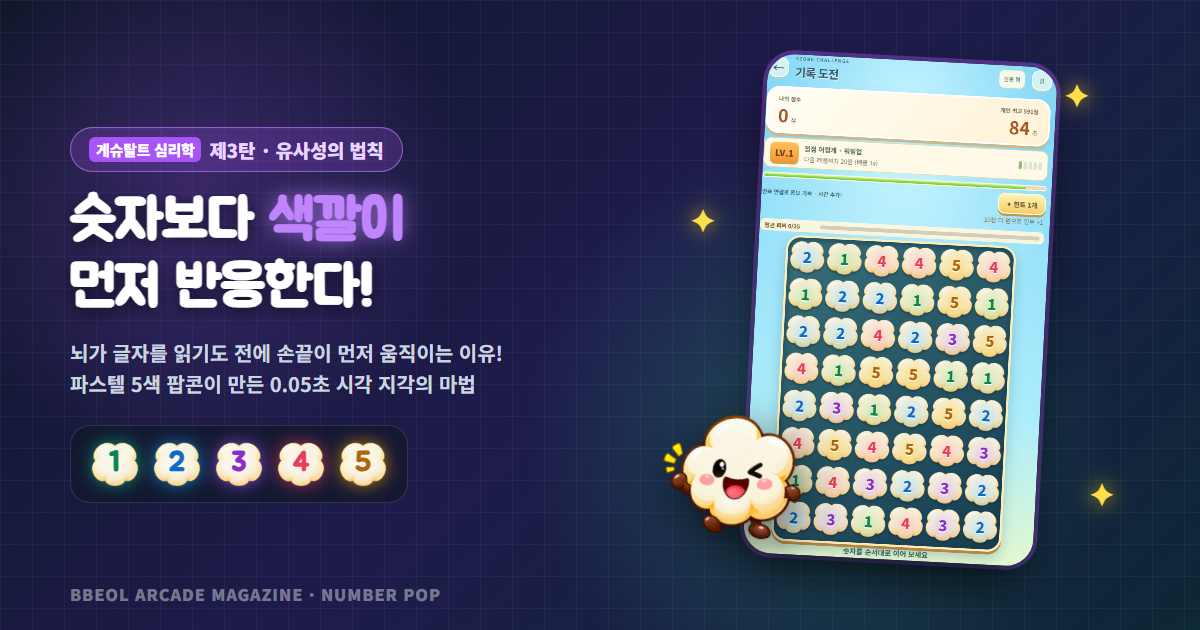
The very same psychological reaction occurs when playing Number Pop. Facing a chaotic board of 48 popcorn kernels, once you lock eyes on number 1, you aren't calculating digits.
"I touched Mint Green (1), and before I could even think, my finger glided directly to the adjacent Sky Blue (2)!"
Why do our hands react to color way faster than our conscious minds compute numbers? The answer lies in the third pillar of Gestalt perception: the 'Law of Similarity'.
Grouping by Color and Shape: Gestalt's 'Law of Similarity'
A century ago, German Gestalt psychologists identified the visual shortcut the human brain relies on most for instant pattern recognition:
Law of Similarity:
When presented with multiple visual elements, human perception instinctively groups items that share visual characteristics—such as color, shape, size, or texture—into a coherent, unified collective.
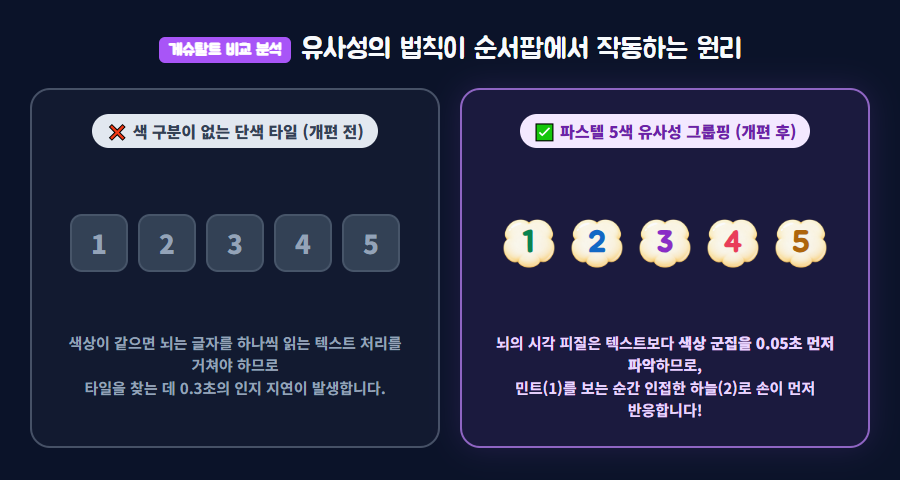
Why does the brain group by visual similarity?
Because the human visual cortex processes color wavelengths and silhouettes over 0.05 seconds faster than higher-level brain centers can decipher symbolic text (like numbers 1, 2, 3...).
A Hard Lesson from History: Spreadsheet Grids vs Pastel Popcorn
To be completely honest, Number Pop's very first prototype completely disregarded this law of similarity.
Back then, a good neighborhood friend test-played the game and delivered a stinging reality check: "Why does this look like an IRS tax audit spreadsheet?!"
His brutal feedback was 100% scientifically accurate.
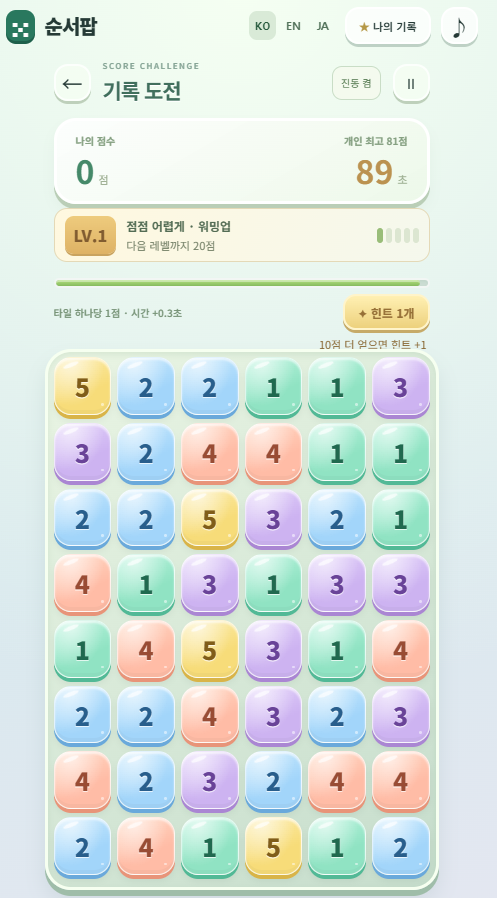
- Before: 48 identical dark blocks gave the brain zero color clues. Players had to mentally read each digit, causing visual fatigue and stuttered reactions.
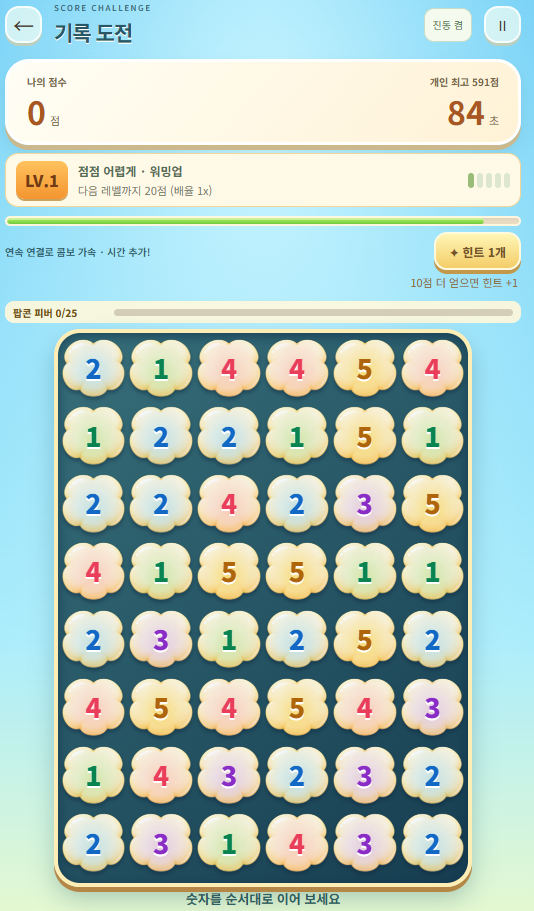
- After: We threw out the rigid squares in favor of puffy popcorn silhouettes, assigning each number a distinct pastel color identity:
- 1: Crisp Mint Green (an intuitive launch signal)
- 2: Cool Sky Blue (natural descent target)
- 3: Gentle Lilac Purple (the bridge step)
- 4: Sweet Coral Pink (rising anticipation)
- 5: Honey Gold Orange (the crescendo finale)
The outcome was dramatic. Even without consciously reading the numbers, players' eyes subconsciously tracked: "Mint goes to Blue, Blue goes to Purple, Purple goes to Pink." The rhythm of play immediately accelerated by three to four times!
Live Gameplay: When 5 Pastel Hues Form a Radiant Rainbow
This law of similarity reaches its peak when you drag across all five pastel colors in sequence, opening a radiant rainbow highway:
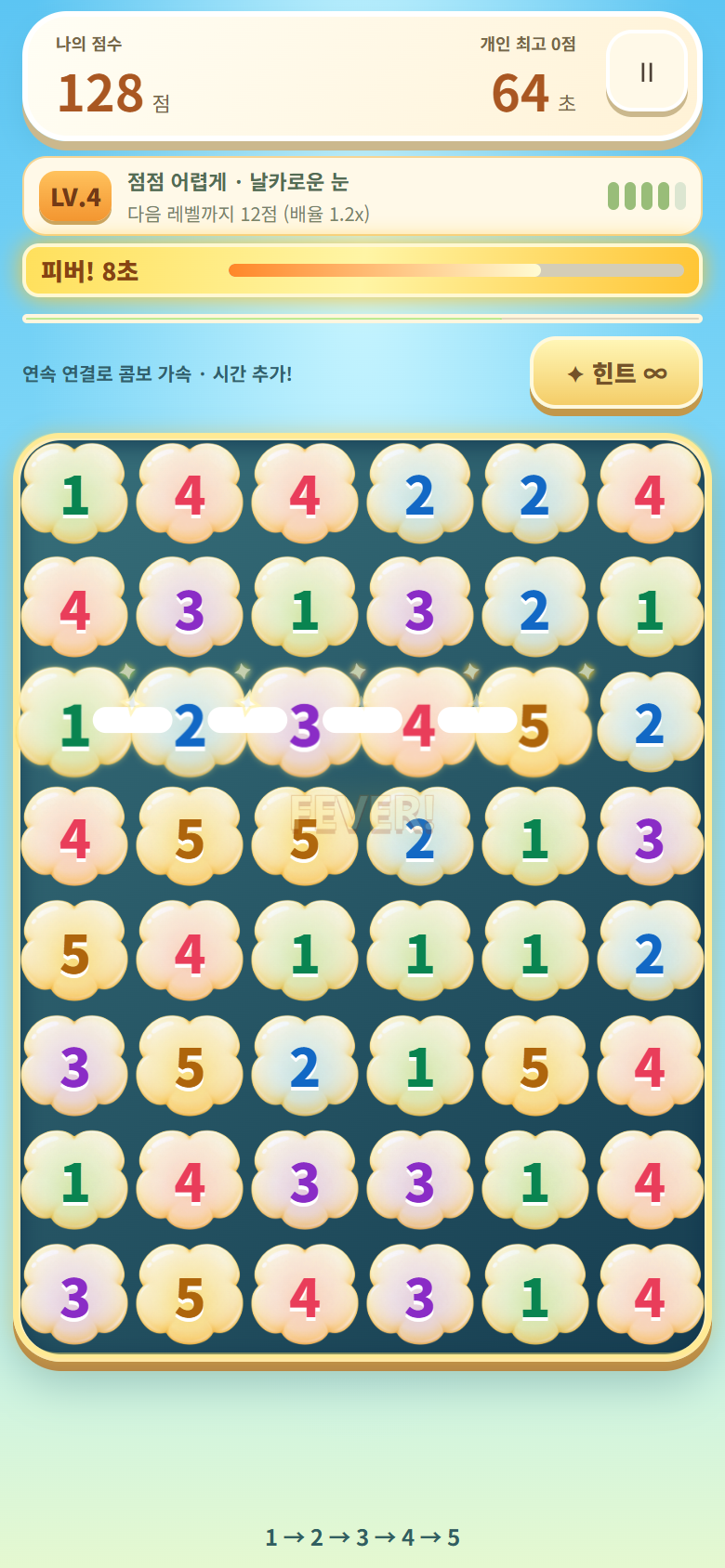
As your fingertip glides across Mint (1), Sky (2), Lilac (3), Pink (4), and Honey (5), your visual cortex basks in the harmonious progression of color and uninterrupted flow.
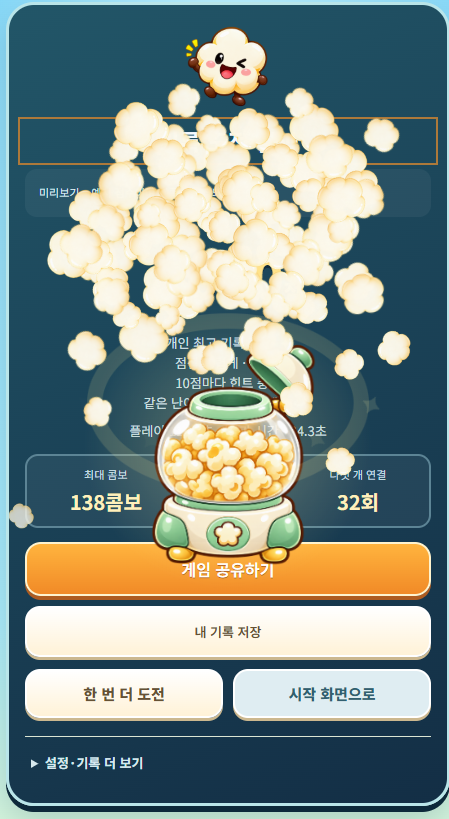
And after 90 seconds of popping, the vintage popcorn machine erupts in full celebration:
⚠️ Frank Confession: "No Color Magic Here!"
Just like in the first two installments, let's keep our promises straight:
You won't hear us making pseudo-scientific promises like "Staring at these pastel shades for 3 minutes a day unlocks 300% more creativity and dissolves all life stress!"
Number Pop is not an artistic miracle tool or a shortcut to genius.
It is simply a refreshing 90-second visual recess where you can rest your eyes from dreary spreadsheets and black-and-white documents, enjoying the cheerful, natural rhythm of pastel popcorn popping under your fingertips.
You don't need high-brow cognitive training to enjoy a game whose colors just feel right.
The Gestalt Trilogy Complete: The Most Satisfying 90 Seconds for Your Eyes
Over these three episodes, we've explored the three Gestalt superpowers hidden inside Number Pop:
- Episode 1: Law of Continuity — How our eyes naturally link scattered points into smooth neon paths (1→2→3 neon trail)
- Episode 2: Law of Closure — How our brains crave finishing open loops (1 through 5 complete closure)
- Episode 3: Law of Similarity — How colors and shapes guide our hands faster than conscious thought (5-color pastel grouping)
When these three visual instincts unite, a humble browser game transforms into an endlessly responsive, instantly satisfying web arcade.
No app downloads, no account setup. Just fire up your browser and pop a hot tub of popcorn!
👉 Play Number Pop Now (Free, Instant Web Play)
[Gestalt Psychology in Number Pop Trilogy Complete]
- Episode 1: Ever Find Faces in Ceiling Patterns? (Law of Continuity)
- Episode 2: Why Getting Stuck on 4 Drives You Crazy (Law of Closure)
- Episode 3: Why Pastel Popcorn Colors Guide Your Hands Automatically (Law of Similarity) ← You are here (Trilogy Complete)